


Syllabus: GS1/Climatology
Context
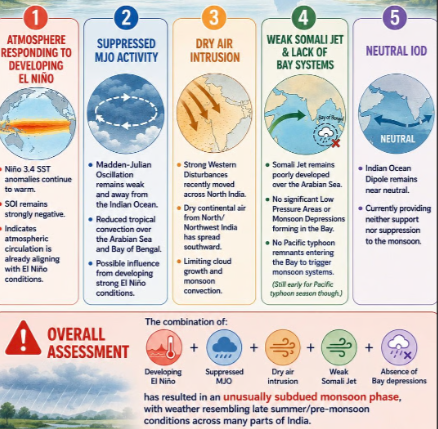
- India’s southwest monsoon may remain weak or stalled for a week, with five rain-suppressing factors active at the same time.
About
- India recorded a 38% countrywide rainfall deficit between June 1 and June 17, with central India facing the highest deficit at 62%.
- Five rain-suppressing factors are: Developing El Niño conditions, weak Madden-Julian Oscillation activity, dry westerly winds, a weak Somali Jet and neutral Indian Ocean Dipole conditions.
Southwest Monsoon
- Onset and Retreat: The monsoon season in India generally starts in early June and lasts until September.
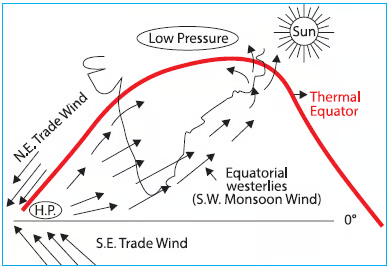
- The onset of the monsoon is marked by the arrival of the southwest monsoon winds, which bring moisture-laden air from the Indian Ocean.
- The withdrawal or retreat of the monsoon typically begins in October.
- The northeast monsoon, occurring from October to December, brings rainfall to parts of southern India.
Factors Impacting Monsoon
El Nino
- El Niño means Little Boy in Spanish. It is a climate phenomenon characterized by the periodic warming of sea surface temperatures in the central and eastern equatorial Pacific Ocean.
- During El Niño, trade winds weaken.
- Warm water is pushed back east, toward the west coast of the Americas and as a result cold water is pushed towards Asia.
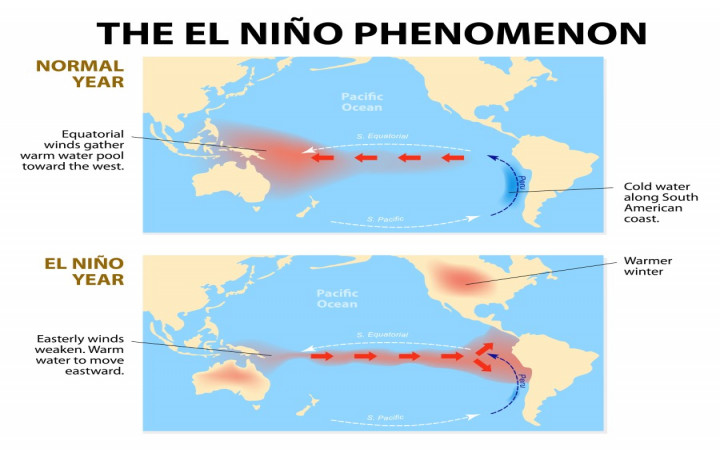
- Impact of El Nino on weather patterns: It leads to rise in global temperature, weakens monsoon, increases risk of wildfires and triggers extreme weather events such as hurricanes, and cyclones, particularly in the Pacific Ocean and Atlantic.
Madden-Julian Oscillation (MJO)
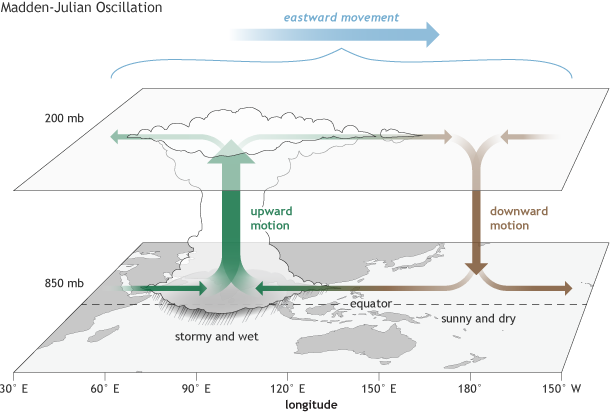
- The MJO is a moving system of winds, clouds, and pressure that brings rain as it circles around the equator. It was discovered in 1971 by Roland Madden and Paul Julian.
- The system travels eastward at 4–8 m/s and circles the globe typically every 30–60 days, though it can take up to 90 days.
- As it moves, strong MJO activity often splits the planet into two parts — one in which the MJO is in active phase and brings rainfall, and the other in which it suppresses rainfall.
- During an active MJO phase, regions within its influence experience above-average rainfall, often due to increased cloud formation, convection, and cyclonic activity.
Western Disturbance
- A Western Disturbance (WD) is an extra-tropical weather system that originates outside India and moves from west to east, bringing rain, snowfall, and storms to northern parts of the Indian subcontinent.
- Origin and Formation: Western disturbances originate over the Mediterranean region, Black Sea, or Caspian Sea.
- They form when cold polar air interacts with warmer, moist air, creating low-pressure systems.
- These systems are carried eastward by westerly winds in the upper atmosphere, particularly the subtropical westerly jet stream.
Indian Ocean Dipole:
- In 1999, N H Saji of Japan discovered an ENSO-like phenomenon in the Indian Ocean which they named the Indian Ocean Dipole (IOD).
- Like ENSO, IOD also has three phases—positive, negative and neutral. During the positive phase of IOD, sea surface temperatures are warmer in the western Indian Ocean which gives a boost to monsoon winds.
- The reverse happens during IOD negative and no gradient is observed during the IOD neutral period.
Somali Jet
- It is a fast moving inter hemispheric cross equatorial flow of air which originates near Mauritius and the northern part of Madagascar in the southern Hemisphere.
- The winds cross the Equator and move along the eastern coast of Africa through Kenya, Ethiopia, and Somalia.
- During May, the jet moves into the Arabian Sea, and by June it reaches the west coast of India.
- As it travels, it carries a large amount of moisture (water vapour) from the ocean.
- When the Somali Jet becomes stronger, it brings heavier and more reliable monsoon rainfall to Peninsular India.
Source: DTE
Previous article
News In Short 18-06-2026
